Electron Configuration & Periodic Trends · Chemistry
CH.1.04·Grade 10·Chemistry
Electron Configuration & Periodic Trends
This LO covers the periodic table's structure, electron configuration, and the trends that make the periodic table one of the most powerful tools in all of science. Learn how atomic radius, ionization energy, electronegativity, and electron affinity change across periods and down groups – and why. Master this, and you'll be able to predict the behaviour of elements you've never even studied.
Essential Question:"What are the ways that people can sort a variety of things?"
Electron Configuration – The Seating Chart of Electrons
Imagine a concert hall with rows of seats at different heights. The cheapest seats (lowest energy) fill first. That's exactly how electrons arrange themselves around the nucleus. Electron configuration describes precisely where every electron in an atom "lives."
Electron Configuration (التوزيع الإلكتروني)
A notation that shows how electrons are distributed among the various atomic orbitals of an atom. In the ground state (lowest energy, most stable state), electrons occupy the lowest available energy levels first.
Orbital (المدار)
A region in space around the nucleus where an electron is most likely to be found. Each orbital can hold a maximum of 2 electrons with opposite spins.
Ground State (الحالة المستقرة)
The lowest energy state of an atom – the most stable arrangement. Electrons fill the lowest available orbitals first.
This is the "default" state of every atom. When we write electron configurations, we almost always mean the ground state.
Excited State (الحالة المثارة)
How was this explanation?
Any energy state above the ground state. An atom becomes excited by absorbing energy (heat, light, electricity), causing an electron to jump to a higher energy orbital.
This state is temporary – the electron will quickly fall back down, releasing the absorbed energy as light (this is how neon signs and fireworks work!).
The Three Rules of Electron "Seating"
Three fundamental rules govern how electrons fill orbitals – break any of them, and the configuration is wrong.
1
1. Aufbau Principle (مبدأ البناء التصاعدي)
"Fill the cheapest seats first."
Electrons are added one at a time to the lowest energy orbitals available before filling higher energy ones. The word "Aufbau" is German for "building up."
The Aufbau diagonal rule – follow the arrows from top to bottom to get the correct filling order. States crossed by the same arrow have the same (n + l) value
Notice that 4s fills before 3d because 4s has lower energy. This is a common exam point!
2
2. Pauli Exclusion Principle (مبدأ باولي للاستبعاد)
"No two electrons can have the same address."
No two electrons in an atom can have the same set of four quantum numbers. The practical result: an orbital can hold a maximum of 2 electrons, and they must have opposite spins (↑↓).
Think of it like a seat on a bus – maximum two people per seat, and they must face opposite directions.
3
3. Hund's Rule (قاعدة هوند)
"Take empty seats before sitting next to someone."
When filling orbitals of equal energy (like the three p orbitals or five d orbitals), electrons occupy each orbital singly first, all with the same spin, before any orbital gets a second electron.
Just like passengers spreading out on a bus – everyone takes their own seat before doubling up.
Exam-critical: Each subshell holds a specific maximum number of electrons:
s subshell: 1 orbital → 2 electrons max
p subshell: 3 orbitals → 6 electrons max
d subshell: 5 orbitals → 10 electrons max
f subshell: 7 orbitals → 14 electrons max
Writing Electron Configurations
There are two ways to write electron configurations:
Lists every occupied orbital with the number of electrons as a superscript.
Examples:
Hydrogen (H, Z=1):1s1
Helium (He, Z=2):1s2
Carbon (C, Z=6):1s22s22p2
Sodium (Na, Z=11):1s22s22p63s1
Calcium (Ca, Z=20):1s22s22p63s23p
Arsenic (As, Z=33):1s22s22p63s23p
Uses the previous noble gas symbol in brackets to represent all filled inner shells, then writes only the outer (valence) electrons.
Examples:
Sodium (Na, Z=11):[Ne]3s1 - Neon has 10 electrons, Na has 11
Calcium (Ca, Z=20):[Ar]4s2 - Argon has 18 electrons, Ca has 20
Arsenic (As, Z=33):
Orbital Diagrams – Visualising Hund's Rule
Orbital diagrams use boxes (or lines) for orbitals and arrows for electrons. An up arrow (↑) = spin +½, down arrow (↓) = spin −½.
Building up from Hydrogen to Neon:
Element
Z
Config
Orbital Diagram (1s)(2s)(2p₁ 2p₂ 2p₃)
H
1
1s1
(↑)( )( _ _ _ )
He
2
1s2
(↑↓)( )( _ _ _ )
Li
3
1s22s1
(↑↓)(↑)( _ _ _ )
Be
4
1s22s2
(↑↓)(↑↓)( _ _ _ )
B
5
1s22s22p1
(↑↓)(↑↓)(↑ _ _ )
C
6
1s22s22p2
(↑↓)(↑↓)(↑ ↑ _ )
N
7
1s22s22p3
(↑↓)(↑↓)(↑ ↑ ↑)
O
8
1s22s22p4
(↑↓)(↑↓)(↑↓ ↑ ↑)
F
9
1s22s22p5
(↑↓)(↑↓)(↑↓ ↑↓ ↑)
Ne
10
1s22s22p6
(↑↓)(↑↓)(↑↓ ↑↓ ↑↓)
Notice Hund's Rule in action at Carbon and Nitrogen: electrons spread out into separate p orbitals (all with the same spin ↑) before any orbital gets a second electron. Oxygen is when pairing begins.
Exceptions to the Aufbau Rule – Special Stability
Some elements "cheat" because having a half-filled (d5) or completely filled (d10) d subshell provides extra stability. The energy gained from this symmetry outweighs the cost of moving an electron from the s orbital.
The two exceptions you MUST know:
Element
Expected
Actual
Why?
Chromium (Cr, Z=24)
[Ar]4s23d4
[Ar]4s13d5
Half-filled d subshell (d5) is extra stable
Copper (Cu, Z=29)
[Ar]4s23d9
[Ar]4s13d
In both cases, one electron "moves" from the 4s to the 3d to achieve the special stability of a half-filled or fully-filled d subshell.
Electron Configurations of Ions
Cations (كاتيونات) – Positive Ions
Formed by losing electrons. Electrons are always removed from the outermost shell (highest n value) first.
Critical rule for transition metals: Remove the ns electrons before the (n−1)d electrons, even though the ns filled first!
Example – Iron:
Fe (Z=26): [Ar]4s23d6
Fe²⁺: Remove 2 electrons from 4s → [Ar]3d6
Fe³⁺: Remove 2 from 4s + 1 from 3d → [Ar]3d5
Anions (أنيونات) – Negative Ions
Formed by gaining electrons. Electrons are added to the highest energy orbital that is not yet full.
Example – Chlorine:
Cl (Z=17): [Ne]3s23p5
Cl⁻: Add 1 electron to 3p → [Ne]3s
Exam trap: For transition metal cations, always remove electrons from the 4s before the 3d (or 5s before 4d, etc.). Even though 4s fills before 3d in neutral atoms, it empties first when forming ions. Think of it as "last in relative energy, first out."
The Modern Periodic Table
The periodic table is the single most useful tool in all of chemistry. Dmitri Mendeleev created the first widely accepted version in 1869 because of its predictive power – he left gaps for elements not yet discovered and correctly predicted their properties. The modern periodic table arranges elements by atomic number (not atomic mass).
Structure – Groups & Periods
Groups (المجموعات) – Vertical Columns
Elements in the same group (column) share the same number of valence electrons and therefore have similar chemical properties.
Numbered 1–18 in the modern IUPAC system
The group number for main-group elements (Groups 1, 2, 13–18) tells you the number of valence electrons
Group 1 → 1 valence electron, Group 2 → 2, Group 13 → 3, … Group 18 → 8 (except He with 2)
Periods (الدورات) – Horizontal Rows
Elements in the same period (row) have the same number of electron shells (same principal energy level n).
Numbered 1–7
Period 1 → 1 shell, Period 2 → 2 shells, Period 3 → 3 shells, etc.
As you move across a period left to right, the atomic number increases by 1
The Four Blocks
The periodic table is divided into four blocks based on which subshell is being filled:
The four blocks of the periodic table – colour-coded by the subshell being filled: s-block (Groups 1–2), d-block (Groups 3–12), p-block (Groups 13–18), and f-block (lanthanides and actinides)
Block
Location
Subshell Being Filled
Groups
s-block
Far left (+ He)
s orbitals
Groups 1–2
p-block
Right side
p orbitals
Groups 13–18
d-block
Centre
d orbitals
Groups 3–12
f-block
Bottom (lanthanides & actinides)
f orbitals
Pulled out below
Quick trick: The block tells you the last subshell being filled. If an element is in the d-block, the outermost electrons being added are in a d orbital. If it's in the p-block, a p orbital is being filled.
Element Families – The Periodic Table's "Neighbourhoods"
Group 1 (except hydrogen)
Valence electrons: 1
Properties: Soft, silvery, extremely reactive – react violently with water, never found pure in nature
Trend: Reactivity increases going down the group (Cs is more reactive than Na)
Stored under kerosene/oil in the lab to prevent reaction with air and moisture
Examples: Li, Na, K, Rb, Cs, Fr
Group 2
Valence electrons: 2
Properties: Reactive metals, but less reactive than alkali metals. Harder and denser than Group 1
Trend: Reactivity increases going down the group
Also not found in pure form in nature
Examples: Be, Mg, Ca, Sr, Ba, Ra
Groups 3–12
Characteristic: Outermost electrons fill d orbitals
Properties: Hard, high melting points, good conductors, often colourful compounds
Can form ions with multiple charges (e.g., Fe²⁺ and Fe³⁺) – hence "transition"
Include many familiar metals: iron, copper, gold, silver, zinc
Group 17
Valence electrons: 7
Properties: Very reactive non-metals, often colourful and corrosive
The name "halogen" means "salt former" (they readily react with metals to form salts like NaCl)
Trend: Reactivity decreases going down the group (F is more reactive than I)
Examples: F (gas), Cl (gas), Br (liquid), I (solid) – note the change in state!
Group 18
Valence electrons: 8 (He has 2) – full outer shell
Electronegativity and electron affinity are effectively zero
Ionization energy is the highest in their period
Examples: He, Ne, Ar, Kr, Xe, Rn
The Zigzag Line
Elements along the staircase line separating metals from non-metals: B, Si, Ge, As, Sb, Te
Properties intermediate between metals and non-metals
Some are semiconductors – essential for electronics (silicon chips!)
May conduct electricity under certain conditions but not others
Periodic Trends – The Predictive Power
The real magic of the periodic table is that properties change predictably across periods and down groups. Understanding why these trends exist (based on nuclear charge and electron shielding) means you never have to memorise individual values.
The two key forces behind ALL periodic trends:
Nuclear charge (الشحنة النووية): More protons → stronger pull on electrons → electrons held tighter
Electron shielding (الحجب الإلكتروني): Inner electrons shield outer electrons from the full nuclear charge. More shells → more shielding → outer electrons held less tightly
Effective nuclear charge = Nuclear charge − Shielding. This is the "net pull" felt by the outermost electrons, and it drives every trend.
Metallic vs Non-metallic Character
Property
Across a Period (→)
Down a Group (↓)
Metallic character
Decreases
Increases
Non-metallic character
Increases
Decreases
The most metallic element is Francium (Fr) – bottom left. The most non-metallic element is Fluorine (F) – top right (excluding noble gases).
Atomic Radius – How Big is the Atom?
Atomic Radius (نصف القطر الذري)
Half the distance between the nuclei of two bonded atoms of the same element. It measures the size of an atom.
Atomic radius INCREASES ↓
Why? Each new period adds a new electron shell. More shells = larger atom. It's like adding another layer to an onion.
Li<Na<K<Rb<Cs
Atomic radius DECREASES →
Why? As you move right, the number of protons increases (higher nuclear charge) but electrons are added to the same shell. The increased nuclear pull draws all electrons closer to the nucleus, shrinking the atom.
Na>Mg>Al>Si>P>S>Cl>Ar
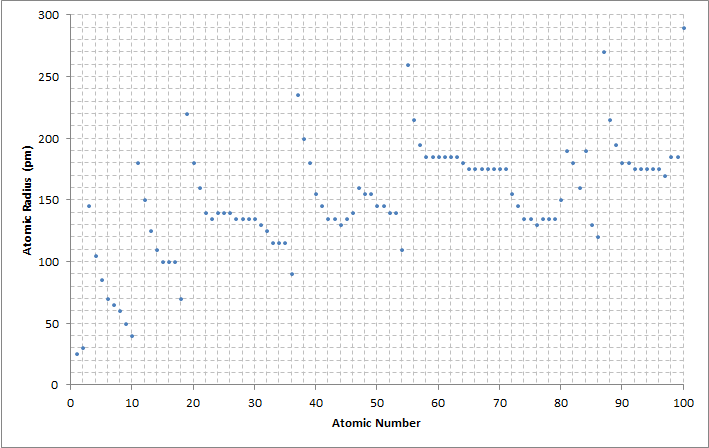
Atomic radius vs atomic number – notice how the radius peaks at each alkali metal (start of a new period/shell) and decreases across each period as nuclear charge increases
Memory trick: Atomic radius increases toward the bottom-left corner of the periodic table. The largest atom is Cesium (Cs) or Francium (Fr). The smallest is Helium (He).
One arrow: ↙ = radius increases
Ionic Radius – How Big is the Ion?
Cations – Smaller Than Parent Atom
Losing electrons means:
Fewer electrons → less electron-electron repulsion
Often an entire shell is lost (e.g., Na → Na⁺ loses the 3rd shell entirely)
The same nuclear charge now pulls on fewer electrons → stronger pull → smaller radius
Example: Na (atomic radius ≈ 186 pm) → Na⁺ (ionic radius ≈ 95 pm) – almost half the size!
Anions – Larger Than Parent Atom
Gaining electrons means:
More electrons → more electron-electron repulsion
The same nuclear charge pulls on more electrons → weaker pull per electron → larger radius
Exam-critical – Comparing isoelectronic species (ions with the same number of electrons):
For ions with the same electron count, the one with more protons is smaller (greater nuclear charge pulling on the same number of electrons).
Example: O²⁻, F⁻, Ne, Na⁺, Mg²⁺ all have 10 electrons:
Species
Protons
Electrons
Relative Size
O²⁻
8
10
Largest (fewest protons pulling 10 e⁻)
F⁻
9
10
↑
Ne
10
10
Middle
Na⁺
11
10
↓
Mg²⁺
12
10
Smallest (most protons pulling 10 e⁻)
Rule: More protons + same electrons = stronger attraction = smaller ion.
Ionization Energy – How Hard is it to Rip an Electron Away?
Ionization Energy (طاقة التأين)
The energy required to remove the most loosely held electron from a gaseous atom in its ground state. It's always a positive value (energy must be absorbed). Higher ionization energy = harder to remove an electron.
X(g)→X(g)++e−ΔH>0
Exam point: Ionization energy must involve a gaseous atom. If the question shows a liquid or solid state, the answer is wrong. Also, ionization energy removes an electron – it does NOT add one (that's electron affinity).
Ionization energy DECREASES ↓
Why? The outermost electron is farther from the nucleus (more shells = more distance + more shielding). It's easier to remove because the nuclear attraction is weaker.
Think of it like holding a dog on a longer leash – easier for someone to take it away!
Ionization energy INCREASES →
Why? Increasing nuclear charge (more protons) holds the electrons more tightly in the same shell. More protons pulling on electrons in the same shell = harder to remove.
First ionization energy vs atomic number – notice the peaks at noble gases (hardest to ionize) and valleys at alkali metals (easiest to ionize). The P > S and N > O exceptions are visible as small dips
Memory trick: Ionization energy increases toward the top-right corner. The trend arrow points ↗.
Noble gases have the highest ionization energies in their period (full, stable shells are hard to break apart).
Successive Ionization Energies
Each time you remove an electron, the next one is harder to remove. Why? Same nuclear charge pulling on fewer electrons = stronger pull on each remaining electron.
Successive ionization energies of Sodium (Na, Z=11):
IE
Value (kJ/mol)
Electron Removed From
1st
496
3s (valence)
2nd
4,562
2p (core)
3rd
6,912
2p (core)
Notice the HUGE jump between the 1st and 2nd IE – from 496 to 4,562 kJ/mol! This tells us:
Na has 1 valence electron (easy to remove)
After that, you're breaking into the core electrons (stable, full inner shell – extremely hard)
The big jump always occurs after all valence electrons are removed
Rule: The position of the dramatic jump in successive IEs tells you the number of valence electrons → confirms the element's group.
The Phosphorus > Sulfur Exception
Phosphorus (P) has a higher first ionization energy than Sulfur (S), even though S is to its right. Why?
P has a half-filled 3p subshell: 3p3 → (↑)(↑)(↑) – extra stable
S has one paired electron: 3p4 → (↑↓)(↑)(↑) – the paired electron experiences repulsion, making it slightly easier to remove
This same exception occurs with N > O in Period 2. Half-filled subshells have special stability!
Electron Affinity – How Much Does an Atom Want an Electron?
Electron Affinity (الألفة الإلكترونية)
The energy change that occurs when an atom in the gaseous state gains one electron. A more negative value indicates a greater tendency to gain an electron (more energy released).
X(g)+e−→X(g)−ΔH<0 (usually)
Electron affinity DECREASES (less negative) ↓
Why? The new electron is added farther from the nucleus (more shells, more shielding). The atom "wants" it less because the nuclear attraction is weaker at greater distance.
Electron affinity INCREASES (more negative) →
Why? Higher nuclear charge attracts the incoming electron more strongly. Non-metals near the right side of the table are close to a full shell and "desperately want" that extra electron.
Electron affinity vs atomic number – halogens (Group 17) show the most negative values (highest tendency to gain electrons), while noble gases and alkaline earth metals have near-zero values
Key exceptions:
Noble gases: Electron affinity ≈ zero. Their outer shell is already full – no room or desire for more electrons.
Beryllium and Magnesium: Electron affinity ≈ zero because their s subshell is fully filled (s2). Adding an electron would mean starting a new, higher-energy subshell.
Chlorine > Fluorine: Chlorine has a higher (more negative) electron affinity than fluorine! Fluorine is so small that adding an electron causes intense electron-electron repulsion in its tiny 2p orbitals.
Group 17 (Halogens) have the most negative electron affinities overall – they're one electron away from a noble gas configuration!
Electronegativity – The Tug-of-War for Shared Electrons
Electronegativity (الكهروسالبية)
A measure of an atom's ability to attract shared electrons toward itself in a chemical bond. Measured on the Pauling scale (relative values, no unit). Higher electronegativity = stronger pull on shared electrons.
Electronegativity DECREASES ↓
Why? More electron shells → bonding electrons are farther from the nucleus → weaker attraction.
Electronegativity INCREASES →
Why? More protons → stronger pull on the shared bonding electrons → higher electronegativity.
Key facts to remember:
Fluorine is the most electronegative element (EN = 4.0)
Francium (or Cesium among stable elements) is the least electronegative
Noble gases are generally assigned zero electronegativity (they rarely form bonds, so the concept doesn't apply)
Electronegativity follows the same trend direction as ionization energy and electron affinity: ↗ (increases toward top-right)
Electronegativity in action – HCl:
In a molecule of HCl, chlorine (EN = 3.16) pulls the shared electrons toward itself much more strongly than hydrogen (EN = 2.20). This creates a polar bond – the chlorine side becomes partially negative (δ⁻) and the hydrogen side becomes partially positive (δ⁺).
The electronegativity difference (ΔEN) between bonded atoms tells you the bond type:
ΔEN = 0 → nonpolar covalent (equal sharing)
0 < ΔEN < 1.7 → polar covalent (unequal sharing)
ΔEN ≥ 1.7 → ionic (electron transfer)
Noble Gases – Why They're "Special" in Trends
Noble gases (Group 18) are often excluded from trend discussions for electronegativity and electron affinity. Here's why:
Their outer shell is completely filled (He: 2 electrons, others: 8 electrons)
They have no tendency to gain, lose, or share electrons
This gives them:
Electronegativity: Effectively zero (no bonds to pull electrons in)
Electron Affinity: Effectively zero (no desire for extra electrons)
Ionization Energy: The highest in their period (hard to break a full, stable shell)
Their inertness is why they're set apart when analysing most trends
Summary of All Trends – One Diagram
All major periodic trends at a glance – notice that atomic radius goes in the opposite direction (↙) from ionization energy, electron affinity, and electronegativity (↗)
Property
Across Period (→)
Down Group (↓)
Trend Arrow
Atomic Radius
Decreases
Increases
↙
Ionic Radius (for same charge type)
Decreases
Increases
↙
Ionization Energy
Increases
Decreases
↗
Electron Affinity (magnitude)
Increases
Decreases
↗
Electronegativity
Increases
Decreases
↗
Metallic Character
Decreases
Increases
↙
Non-metallic Character
Increases
Decreases
↗
The ultimate shortcut: There are really only two arrows to remember:
↙ (bottom-left): Atomic radius, metallic character
↗ (top-right): Ionization energy, electron affinity, electronegativity, non-metallic character
Atomic radius is the "odd one out" – it goes the opposite direction from everything else. This makes sense: smaller atoms hold electrons tighter (higher IE, EA, EN), while larger atoms let them go easily (more metallic).
Metals, Non-metals & Metalloids
Location: Left and centre of the periodic table (most elements are metals!)
Physical properties:
Shiny (lustrous), silvery appearance
Malleable (can be hammered into sheets) and ductile (can be drawn into wires)
Good conductors of heat and electricity
Generally high melting and boiling points
Solid at room temperature (except mercury, Hg – liquid)
Chemical properties:
Tend to lose electrons → form cations (positive ions)
Low ionization energy, low electronegativity
Metal oxides are basic (dissolve in water to form bases)
React with acids to produce hydrogen gas and a salt
Can be solid, liquid (bromine), or gas at room temperature
Chemical properties:
Tend to gain electrons → form anions (negative ions)
High ionization energy, high electronegativity
Non-metal oxides are acidic (dissolve in water to form acids)
Location: Along the "staircase" zigzag line
Properties – intermediate between metals and non-metals:
May be shiny or dull
Somewhat brittle
Semiconductors – conduct electricity under certain conditions but not others
This makes them essential for electronics (silicon chips, germanium transistors)
The metalloids: B, Si, Ge, As, Sb, Te (and sometimes Po and At)
How to Approach Periodic Table Questions
1
Step 1: Write the Electron Configuration
Determine the complete or abbreviated electron configuration. This tells you exactly where the electrons are.
2
Step 2: Identify the Number of Electrons
Confirm the total number of electrons = atomic number (Z) for a neutral atom, or adjust for ions.
3
Step 3: Identify the Valence Electrons
Find the electrons in the outermost energy level (highest n value). These are the valence electrons – they determine the element's group, reactivity, and trends.
Chlorine (Cl, Z = 17):
Configuration:1s22s22p63s23p5 or [Ne]3s23p5
Total electrons: 17
Valence electrons: 7 (in the 3s and 3p orbitals, n = 3)
→ Group 17 → high electronegativity → high electron affinity → halogen!
Skills Practised in This LO
Vocabulary
Key Terms – LO 4
Electron Configuration (التوزيع الإلكتروني)
The arrangement of electrons in an atom's orbitals, showing which energy levels and subshells are occupied.
Aufbau Principle (مبدأ البناء التصاعدي)
Electrons fill orbitals starting from the lowest energy level and working upward.
Pauli Exclusion Principle (مبدأ باولي)
No two electrons in an atom can have the same four quantum numbers; max 2 electrons per orbital with opposite spins.
Hund's Rule (قاعدة هوند)
Electrons occupy degenerate orbitals singly (same spin) before pairing up.
Ground State (الحالة المستقرة)
The lowest energy configuration of an atom's electrons.
Excited State (الحالة المثارة)
A higher-energy state reached when an electron absorbs energy and jumps to a higher orbital.
Valence Electrons (إلكترونات التكافؤ)
Electrons in the outermost energy level; they determine chemical behaviour and bonding.
Core Electrons (الإلكترونات الداخلية)
Inner electrons that shield valence electrons from the full nuclear charge.
Group (المجموعة)
A vertical column in the periodic table; elements in the same group have the same number of valence electrons.
Period (الدورة)
A horizontal row in the periodic table; elements in the same period have the same number of electron shells.
Atomic Radius (نصف القطر الذري)
Half the distance between nuclei of two bonded identical atoms; a measure of atom size.
Ionic Radius (نصف القطر الأيوني)
The radius of an ion; cations are smaller and anions are larger than their parent atoms.
Ionization Energy (طاقة التأين)
Energy required to remove the most loosely held electron from a gaseous atom.
Electron Affinity (الألفة الإلكترونية)
Energy change when a gaseous atom gains an electron; more negative = greater tendency to gain.
Electronegativity (الكهروسالبية)
An atom's ability to attract shared electrons in a chemical bond (Pauling scale).
Effective Nuclear Charge (الشحنة النووية الفعالة)
The net positive charge experienced by valence electrons after accounting for shielding by inner electrons.
Alkali Metals (الفلزات القلوية)
Group 1 elements (except H); 1 valence electron, extremely reactive metals.
Alkaline Earth Metals (الفلزات القلوية الأرضية)
Group 2 elements; 2 valence electrons, reactive metals (less than Group 1).
Halogens (الهالوجينات)
Group 17 elements; 7 valence electrons, very reactive non-metals, "salt formers."
Noble Gases (الغازات النبيلة)
Group 18 elements; full valence shell, extremely unreactive (inert).
Transition Metals (الفلزات الانتقالية)
Groups 3–12; d-block elements, can form multiple ion charges, often colourful compounds.
Metalloids (أشباه الفلزات)
Elements along the zigzag line (B, Si, Ge, As, Sb, Te); properties intermediate between metals and non-metals; semiconductors.
Semiconductor (شبه موصل)
A material that conducts electricity under certain conditions; metalloids like silicon are key semiconductors.
Isoelectronic (متساوي الإلكترونات)
Species (atoms or ions) that have the same number of electrons.
Key Takeaways
What You Need to Remember
Electron configuration follows three rules: Aufbau (lowest energy first), Pauli (max 2 per orbital, opposite spins), and Hund (spread out before pairing).
Aufbau order: 1s → 2s → 2p → 3s → 3p → 4s → 3d → 4p → 5s → ... Note that 4s fills before 3d.
Exceptions: Cr is [Ar]4s13d5 (half-filled d) and Cu is [Ar]4s13d10 (fully-filled d) for extra stability.
Ion configurations: For cations, remove electrons from the outermost shell first (ns before (n-1)d). For anions, add electrons to the highest energy unfilled orbital.
Groups (vertical) share the same number of valence electrons and similar chemistry. Periods (horizontal) share the same number of electron shells.
Atomic radius increases ↙ (down and left). All other trends (IE, EA, EN) increase ↗ (up and right). Only two arrows to remember!
Ionization energy is inversely related to atomic radius: smaller atom → electrons held tighter → higher IE.
Successive ionization energies always increase. A dramatic jump indicates you've broken into the core electrons, revealing the number of valence electrons.
Electron affinity exception: Cl > F because fluorine's tiny size causes excessive electron-electron repulsion.
Electronegativity measures pull on shared electrons. Fluorine (4.0) is highest. Noble gases = 0.
Cations are smaller than parent atoms; anions are larger. For isoelectronic species, more protons = smaller radius.
Metals (left): lose electrons, form cations, basic oxides, good conductors. Non-metals (right): gain electrons, form anions, acidic oxides, insulators. Metalloids (zigzag): semiconductors, intermediate properties.
Test Yourself
Questions sourced from STEM exams, reference materials, and chemistry question banks. These cover all key concepts – periodic table structure, trends, atomic/ionic radius, ionization energy, electronegativity, electron affinity, and metal/non-metal classification.
Concepts 1–6: Structure, Trends, Radius, IE, EN, EA
1. Which one of these atoms or ions has the smallest atomic radius?
2. Which of the following processes represents the ionization potential of chlorine?
3. The table provides properties of fictitious elements D, E, G & M. Which elements are most likely metalloids? (D: low IE, low EN, low conductivity; E: low IE, low EN, high conductivity; G: high IE, high EN, low conductivity; M: high IE, high EN, high conductivity)
4. In the periodic table, the most active metallic elements are found in...
5. Which gives the correct matching of halogens to their properties? (F, Cl, Br, I matched with: smallest IE, highest EA, smallest atomic radius, liquid at room temperature)
6. The ionization potential of phosphorus (₁₅P) compared with sulfur (₁₆S) is:
7. The element (X) found in the third period whose oxide has the formula XO₂, its atomic number will be...
8. Elements of the same group have atomic radii (Å): A=1.96, B=2.27, C=1.52, D=2.48. Which statement is correct?
9. If the 2nd IE = +495 kJ/mol and 3rd IE = +4560 kJ/mol for an element, this element is characterised as:
10. X and Y are in the same period. Atomic radii: X = 0.157 Å, Y = 1.04 Å. When they react together:
11. Which of the following has the largest second ionization energy?
12. Arrange metals A, B, C, D in increasing order of reactivity based on displacement reactions. (A displaces Cu; B displaces Fe but not Zn; C displaces only Ag; D displaces nothing)
13. Which gives the correct order for atomic radius for Mg, Na, P, Si and Ar?
14. The similar chemical behaviour of elements in a given family is best accounted for by atoms having:
15. Within Period 2, what happens as the atomic number increases?
16. As elements of Group 15 are considered from top to bottom, what happens?
17. Which properties are most common in nonmetals?
18. Which property generally decreases across the periodic table from sodium to chlorine?
19. The effective nuclear charge experienced by the outermost electron of Na differs from Ne. This best accounts for:
20. Which group of atoms should have similar chemical behaviour?
21. Which ion has the largest radius?
22. Elements that have similar properties are aligned in vertical columns called:
23. The first ionization energy of Mg is 735 kJ/mol. The second ionization energy is:
24. Choose the element with the highest ionization energy.
25. Which concerning second ionization energies is true?
26. Consider: I. Na⁺ < Mg²⁺ < Al³⁺ < Si⁴⁺ II. Be < Mg < Ca < Sr III. I < Br < Cl < F IV. Al < Si < P < Cl - Which gives correct trend(s) in ionization energy?
27. Which statement is true about the ionization energy of Mg⁺?
28. Which list of atoms is arranged in order of DECREASING atomic radius?
Concept 7: Metals, Non-metals & Metalloids
29. Na⁺ has 12 neutrons and 10 electrons. Which statement is correct?
30. What are the ions present in Na₂O?
31. Given electron configurations: A⁻¹ = [Ne], B²⁺ = [Ne], C = [Ar]4s¹, D = [Ne]3s¹. Arrange by electronegativity:
32. Which oxide dissolves in water to form an acidic solution?
33. Which element is ductile and malleable?
34. Which metal does NOT react with hydrochloric acid?
35. An element has a first ionization energy of 27.9 × 10⁻¹⁹ J and an electronegativity of 4.0. How is this element best classified?
36. An element has the configuration [Kr] 5s² 4d¹⁰ 5p². The element is a(n):
37. An element E has the configuration [Kr] 5s² 4d¹⁰ 5p². The formula for the fluoride of E is most likely:
38. An element with configuration [Xe] 6s² 4f¹⁴ 5d⁷ belongs to which class?
39. All alkaline earths have the following number of valence electrons:
6
4
s2
6
4
s2
3
d10
4
p3
[Ar]4s23d104p3
Iron (Fe, Z=26):[Ar]4s23d6
This shorthand is faster and highlights the valence electrons that determine chemical behaviour.
10
Fully-filled d subshell (d10) is extra stable
2
3
p6
The chloride ion now has the same electron configuration as Argon – a full outer shell!