Light, Electrons & the Electromagnetic Spectrum · Chemistry
CH.1.03·Grade 10·Chemistry
Light, Electrons & the Electromagnetic Spectrum
Ever watched fireworks explode into red, green, blue, and gold? Each colour comes from a different metal salt burning in the flame – strontium for red, barium for green, copper for blue. But why do different elements produce different colours? The answer lies in the quantum world of electrons – how they absorb energy, jump to higher levels, and release light when they fall back down. This LO connects atomic structure, quantum numbers, electromagnetic radiation, and the photoelectric effect into one beautiful, unified story. Master it, and you'll never look at a streetlamp the same way again.
Essential Question:"How do fireworks create different colors?"
The Atom – A Quick Refresher
Before we dive into light and energy, let's make sure the atomic foundations are rock-solid.
Electrons – The Stars of This Story
Electron (الإلكترون)
A negatively charged subatomic particle that exists in energy levels (shells) surrounding the nucleus. Electrons are responsible for all chemical behaviour – bonding, reactions, and the emission of light.
Valence Electrons (إلكترونات التكافؤ)
The electrons in the outermost energy level (highest n value). These determine:
How an element reacts chemically
The element's valence (combining power)
The element's position in its group
Example: Sodium (Na) has 1 valence electron → Group 1 → easily loses it to form Na⁺.
Core Electrons (الإلكترونات الداخلية)
All electrons in inner energy levels (below the outermost). They:
Shield valence electrons from the full nuclear charge
Generally do not participate in chemical reactions
How was this explanation?
Remain unchanged in most chemical processes
Example: Sodium's core electrons are the 10 electrons in the 1s, 2s, and 2p orbitals.
Key constants to know:
Property
Value
Charge
e=1.60×10⁻¹⁹ C (negative)
Mass
me=9.11×10⁻³¹ kg
The Nucleus – Identity & Stability
Nucleus (النواة)
The dense, positively charged centre of the atom containing protons (positive, determine the element's identity) and neutrons (neutral, provide nuclear stability by offsetting proton-proton repulsion). The nucleus contains virtually all of the atom's mass.
Identity rule: The number of protons = atomic number = element identity. 6 protons = carbon. Always. Neutrons can vary (isotopes), electrons can be gained/lost (ions), but the proton count defines what element you have.
Quantum Numbers – The Electron's Complete Address
Think of quantum numbers as an electron's postal address. Just like a full address tells you the country, city, street, and apartment number, four quantum numbers tell you everything about where an electron lives and how it behaves. No two electrons in an atom can share the exact same four numbers – this is the Pauli Exclusion Principle.
Principal Quantum Number (n)
What it tells you: Which energy level (shell) the electron is in – like which floor of a building.
n
Shell Letter
Subshells Available
Max Electrons (2n2)
1
K
s only
2
2
L
s, p
8
3
M
s, p, d
18
4
N
s, p, d, f
32
5
O
s, p, d, f
50
Rules:
n=1,2,3,4,5,6,7 (positive integers only)
Higher n → farther from nucleus → higher energy
Number of orbitals in level n = n2
Maximum electrons in level n = 2n2
Angular Momentum Quantum Number (ℓ)
What it tells you: The shape and type of subshell (sublevel) – like what type of room (studio, suite, penthouse).
ℓ
Subshell
Shape
Orbitals
Max e⁻
0
s
Spherical
1
2
1
p
Dumbbell
3
6
2
d
Double dumbbell (cloverleaf)
5
10
3
f
Complex / multiple lobes
7
14
Rules:
ℓ ranges from 0 to n−1
If n=1: ℓ can only be 0 (only s subshell exists)
Magnetic Quantum Number (mₗ)
What it tells you: Which specific orbital within the subshell – like the room number on a floor.
Rule:mℓ ranges from −ℓ to +ℓ (including zero).
Subshell
ℓ
Possible mₗ values
Number of orbitals
s
0
0
1
p
1
−1, 0, +1
3
d
2
−2, −1, 0, +1, +2
5
f
3
−3, −2, −1, 0, +1, +2, +3
7
Each individual orbital can hold a maximum of 2 electrons.
For p orbitals, the three orientations correspond to the three spatial axes: , , and .
Spin Quantum Number (mₛ)
What it tells you: The spin direction of the electron – like which bed in a double room (top bunk or bottom bunk).
Only two possible values: +21 (spin up, ↑) or −21 (spin down, ↓)
Two electrons in the same orbital must have opposite spins (Pauli Exclusion Principle)
Reading an electron's full address:
An electron with quantum numbers n=3,ℓ=1,mℓ=0,ms=+21 tells us:
Quantum Number
Value
Meaning
n=3
Energy level 3
3rd floor (M shell)
ℓ=1
p subshell
Dumbbell-shaped room
mℓ=0
Middle p orbital
Room number 0 (the orbital)
So this electron is in the 3p subshell, in the middle orbital, with spin-up. Its address: 3p, orbital 0, spin ↑.
How to spot invalid quantum numbers on exams: Check these three rules in order:
n must be a positive integer (1, 2, 3, …)
ℓ must satisfy: 0≤ℓ≤n−1
mℓ must satisfy: −ℓ≤mℓ≤+ℓ
If any rule is broken, the set of quantum numbers is not allowed.
Example:n=1,ℓ=1 → INVALID because ℓ must be less than n, but 1<1.
Atomic Orbitals vs Orbits – The Modern Truth
Orbit (Bohr Model – المدار الدائري)
A definite, circular path that an electron follows around the nucleus – like a planet orbiting the Sun.
Fixed, predictable trajectory
You know exactly where the electron is at any moment
Was the model proposed by Niels Bohr (1913)
Outdated – but Bohr was right about one thing: energy is quantized
Orbital (Quantum Model – الفلك الذري)
A 3D region of space where an electron is most likely to be found – a probability cloud, not a fixed path.
You can never know exactly where the electron is (Heisenberg Uncertainty Principle)
You only know the probability of finding it in a certain region
Different shapes: s (sphere), p (dumbbell), d (cloverleaf), f (complex)
This is the correct, modern model
Orbital probability density distributions for hydrogen – brighter regions indicate higher probability of finding the electron. Notice the spherical s orbitals, dumbbell-shaped p orbitals, and cloverleaf d orbitals
What Bohr got right: Even though electrons don't travel in neat circular paths, Bohr's key insight was correct – electron energies are quantized. Electrons can only have specific energy values (like steps on a staircase), not any value in between. They cannot exist between energy levels.
Electron Configuration – The Seating Chart
Electron configuration tells you exactly where every electron in an atom lives. Think of it as a seating chart assigning each electron to its proper energy level and subshell.
The Three Rules
1
1. Aufbau Principle – Fill lowest energy first
Electrons fill orbitals starting from the lowest energy and working upward. "Aufbau" is German for "building up."
Notice: 4s fills before 3d, and 5s fills before 4d. This is because the energy of an orbital depends on (n+ℓ), not just n.
The Aufbau diagonal rule – follow the arrows from top to bottom to get the correct filling order
2
2. Hund's Rule – Spread out before pairing
When filling orbitals of equal energy (like the three p orbitals), place one electron in each orbital first (all with the same spin ↑) before adding a second electron to any orbital.
Think of it like sitting on a bus – everyone picks an empty seat before sitting next to a stranger.
3
3. Pauli Exclusion Principle – Max 2 per orbital, opposite spins
No two electrons can have the same four quantum numbers. Each orbital holds a maximum of 2 electrons, and they must have opposite spins (↑↓).
Subshell Capacities
Subshell
Orbitals
Max Electrons
s
1
2
p
3
6
d
5
10
f
7
14
The Diagonal Rule – A Memory Trick
Write out the subshells in a grid and draw diagonal arrows:
Singing it helps! Memorise the letter pattern: s, s, ps, ps, dps, dps, fdps, fdp. Write the numbers starting from 1 for each letter type, and you'll reconstruct the entire filling order in seconds.
Worked Examples
Special Stability – The Cr and Cu Exceptions
Some atoms "cheat" because a half-filled (d5) or fully filled (d10) d subshell is extra stable. The symmetry of having every d orbital equally occupied provides a stability bonus.
The two exceptions you MUST memorise:
Element
Expected Config
Actual Config
Why?
Chromium (Cr, Z=24)
[Ar]4s23d4
[Ar]4s13d5
Half-filled d (d5) is extra stable
Copper (Cu, Z=29)
[Ar]4s23d9
[Ar]4s13d
The rule: There are nod4 or d9 configurations in reality. An electron "borrows" from the 4s to complete the more stable half-filled or fully-filled d arrangement.
Electron Configurations of Ions (Cations)
When a metal atom forms a positive ion, electrons are removed from the outermost shell first (highest n value).
Critical rule for transition metals: Remove the ns electrons before the (n−1)d electrons, even though ns filled first! Think: "last in energy terms, first out."
Element X (Z = 22, Titanium):
Atom:[Ar]4s23d2
X⁺ (lose 1e⁻): Remove from 4s first → [Ar]4s13d2
X²⁺ (lose 2e⁻): Remove both 4s electrons → [Ar]3d2
X³⁺ (lose 3e⁻): Remove from 3d now → [Ar]3d1
For ions, always write the atom's configuration first, then remove from the outermost shell!
Valence Electrons – The Important Ones
Valence Electrons (إلكترونات التكافؤ)
The electrons in the outermost (farthest) energy level from the nucleus. They determine an element's chemical behaviour, bonding capacity, and position in the periodic table. For main-group elements, the number of valence electrons equals the group number.
Don't confuse "outermost" with "highest energy"! For an atom like [Ar]4s23d3:
The outermost electrons (highest n) are in 4s → these are the valence electrons
The highest energy electrons are in 3d
Valence electrons = those in the 4th shell = 2 (the 4s electrons)
When making ions, you remove the outermost (4s) first, not the highest energy (3d)
The Electromagnetic Spectrum
Now we shift from the world of electrons to the world of light – and we'll soon see they're deeply connected.
Electromagnetic Spectrum (الطيف الكهرومغناطيسي)
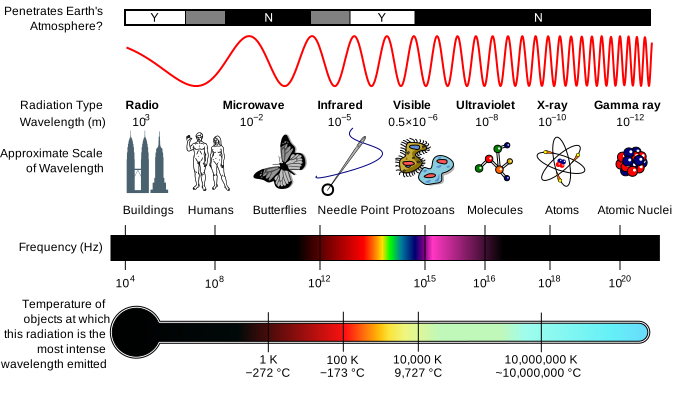
The complete range of electromagnetic radiation, from low-energy radio waves to high-energy gamma rays. All electromagnetic waves travel at the speed of light in a vacuum and differ only in their frequency, wavelength, and energy.
The Full Spectrum – From Gentle to Deadly
Type
Wavelength
Frequency
Energy
Uses
Hazards
Radio
Longest
Lowest
Lowest
TV, radio signals; reflect off ionosphere
None proven
Microwaves
↓
↓
↓
Satellite comms, mobile phones, microwave ovens
Burns (intense)
Infrared (IR)
↓
↓
↓
Thermal imaging, optical fibres, grills
Burns (intense)
Visible (ROYGBIV)
↓
↓
↓
Sight, optical fibres
None
Ultraviolet (UV)
↓
↓
↓
Sunbeds, security inks, sterilisation
Skin cancer
X-rays
↓
↓
↓
Medical imaging (bones)
Ionisation → cell damage, cancer
Gamma rays
Shortest
Highest
Highest
Kill bacteria, sterilise, cancer radiotherapy
Ionisation → DNA damage, cancer
Key facts about ALL electromagnetic waves:
Travel at the speed of light in vacuum: c=3.00×10⁸ m/s
Can be reflected, refracted, and diffracted
Are transverse waves (oscillating electric and magnetic fields perpendicular to direction of travel)
The only difference between types is frequency/wavelength/energy
The electromagnetic spectrum – from long-wavelength, low-energy radio waves to short-wavelength, high-energy gamma rays. Visible light occupies a tiny sliver in the middle
Visible Light – The Rainbow Slice
Within the visible spectrum, colours range from red (longest wavelength, ~700 nm) to violet (shortest wavelength, ~400 nm):
Red→Orange→Yellow→Green→Blue→Indigo→Violet
Remember:ROYGBIV – or the mnemonic "Richard Of York Gave Battle In Vain"
As you move from red → violet: wavelength decreases, frequency increases, energy increases. Red light is the most "gentle" visible light; violet is the most energetic.
Ionising vs Non-ionising Radiation
Non-ionising (Radio → Visible)
Low energy – not enough to remove electrons from atoms
High energy – enough to knock electrons off atoms (ionisation)
Can damage DNA, cause mutations, and lead to cancer
Workers must minimise exposure; lead shielding used for X-rays
Includes: UV (partially), X-rays, gamma rays
Wave Properties & Key Equations
Light behaves as a wave, and understanding wave properties is essential for solving problems.
Wave Vocabulary
Frequency (التردد)
The number of complete wave cycles passing a point per second. Symbol: f or ν (Greek letter "nu"). Unit: Hertz (Hz) = s−1.
Wavelength (الطول الموجي)
The distance between two consecutive identical points on a wave (e.g., crest to crest, or trough to trough). Symbol: λ (Greek letter "lambda"). Unit: metres (m).
Amplitude (السعة)
The maximum displacement from the equilibrium (rest) position to a crest or trough. Amplitude relates to intensity (brightness for light, loudness for sound) – not to energy per photon.
The Three Fundamental Relationships
As wavelength increases, frequency decreases (and vice versa). They are inversely related through the speed of light:
c=λf
Where c=3.00×10⁸ m/s, λ = wavelength in metres, f = frequency in Hz.
Rearranged: λ = c / f and f = c / λ
Higher frequency = more energy per photon. This is why gamma rays are dangerous and radio waves are harmless.
E=hf
Where h=6.63×10⁻³⁴ J·s (Planck's constant) and f = frequency in Hz.
Shorter wavelength = more energy. Combining the two equations above:
E=hc/λ
This single equation connects energy directly to wavelength – very useful for calculations!
Summary of Relationships
If this increases...
Then...
Relationship
Wavelength (λ) ↑
Frequency (f) ↓
Inversely proportional
Wavelength (λ) ↑
Energy (E) ↓
Inversely proportional
Frequency (f) ↑
Energy (E) ↑
Directly proportional
The golden rule: High frequency = short wavelength = high energy. Low frequency = long wavelength = low energy. Gamma rays have the highest frequency, shortest wavelength, and most energy. Radio waves have the lowest frequency, longest wavelength, and least energy.
Additional Important Equations
Photons & the Quantum Nature of Light
Here's where physics got weird – and beautiful. Classical physics said light was purely a wave. But experiments in the early 1900s proved that light also behaves like a stream of particles called photons. This wave-particle duality is one of the most profound discoveries in all of science.
Photon (الفوتون)
The smallest indivisible packet (quantum) of electromagnetic energy. Each photon carries a specific amount of energy determined by its frequency: E=hf. Photons have zero rest mass but carry momentum.
Max Planck's revolution (1900): Energy is NOT continuous – it comes in discrete packets called quanta. This was radical. Imagine being told you can only walk up stairs, never a ramp – you can stand on step 1 or step 2, but never between them. That's what quantisation means for energy.
The Photoelectric Effect – Einstein's Nobel Prize
Photoelectric Effect (الظاهرة الكهروضوئية)
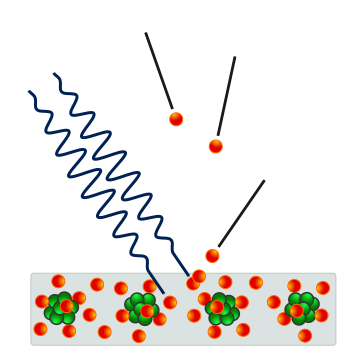
The emission of electrons from a metal surface when light of sufficient frequency strikes it. This phenomenon proved that light consists of particles (photons) and earned Einstein the 1921 Nobel Prize in Physics.
1
The Observation
When light shines on certain metals, electrons are ejected from the surface. These ejected electrons are called photoelectrons.
2
The Surprise
Classical wave theory predicted that brighter light (higher intensity) should eject electrons regardless of colour. But experiments showed:
Red light (low frequency) could never eject electrons from certain metals, no matter how bright
Violet light (high frequency) ejected electrons even at very low intensity
This contradicted the wave model completely!
3
Einstein's Explanation
Light consists of photons, each carrying energy E=hf. A single photon interacts with a single electron:
If the photon's energy ≥ the work function (hν0) of the metal → electron is ejected
If the photon's energy < the work function → nothing happens, regardless of how many photons hit
Extra energy (above the work function) becomes the electron's kinetic energy
The photoelectric effect – photons (light particles) with sufficient energy strike a metal surface, transferring their energy to electrons. If the photon energy exceeds the work function, the electron is ejected
KEelectron=hf−hν0=hf−ϕ
Where:
KE = kinetic energy of the ejected electron
hf = energy of the incoming photon
hν0=ϕ = work function (minimum energy needed to free an electron from the metal)
ν0 = threshold frequency (minimum frequency needed)
Critical exam points about the photoelectric effect:
Frequency matters, not intensity. Below the threshold frequency, NO electrons are ejected – even with incredibly bright light
Above threshold: increasing intensity (more photons) ejects more electrons but doesn't change their kinetic energy
Above threshold: increasing frequency gives ejected electrons more kinetic energy
One photon → one electron. Energy transfer is one-to-one
This proves wave-particle duality – light behaves as both a wave AND a particle
Analogy – The Heavy Box:
Imagine trying to push a heavy box off a table:
Gentle pushes (low frequency photons) will never move it, no matter how many gentle pushes you give (high intensity doesn't help)
One strong push (high frequency photon) can knock it off
An even stronger push sends it off with extra speed (kinetic energy)
The "minimum push needed" = the work function. Extra force beyond that = the electron's kinetic energy.
Hydrogen Emission Spectrum – The Atomic Barcode
If electrons could have any energy value, heating hydrogen would produce a continuous rainbow of all colours. Instead, we see something remarkable – only specific, discrete lines of colour appear, like a barcode.
Line Emission Spectrum (طيف الانبعاث الخطي)
A spectrum consisting of only specific wavelengths (coloured lines) separated by dark gaps. Each element produces a unique set of lines – an atomic fingerprint. The line spectrum of hydrogen proves that electron energies are quantized.
Continuous Spectrum (الطيف المتصل)
Contains all wavelengths with no gaps – like a full rainbow. Produced by hot, dense objects (the Sun, a heated filament).
If energy were NOT quantized, hydrogen would produce this. But it doesn't!
Line (Discrete) Spectrum (الطيف الخطي)
Contains only specific wavelengths – discrete coloured lines on a dark background. Produced by excited atoms of individual elements.
Each line corresponds to a specific electron transition between energy levels. This proves energy is quantized!
The hydrogen emission spectrum – only specific wavelengths appear as bright lines, proving that electron energies are quantised. Each line corresponds to a specific electron transition
Why this matters: The fact that hydrogen only emits light at specific wavelengths is direct proof that electrons can only exist at specific energy levels – like standing on the steps of a staircase. If you could stand anywhere (continuous energy), you'd see all colours. Since you see only certain colours, the energy levels must be fixed.
Ground State, Excited State & Electron Transitions
This is where everything comes together – atomic structure meets light emission.
Ground State (الحالة المستقرة)
The lowest energy configuration of an atom. All electrons are in their lowest possible energy levels. This is the most stable state – where atoms "want" to be.
Think of it as standing on the bottom step of a staircase. You're comfortable here.
Excited State (الحالة المثارة)
Any configuration where one or more electrons have absorbed energy and jumped to a higher energy level. This state is unstable and temporary – like balancing on a high step. The electron quickly falls back down.
An atom enters the excited state by absorbing energy from heat, light, or electricity.
The Absorption-Emission Cycle
1
1. Absorption – Electron Jumps Up
The atom absorbs a specific amount of energy (a photon, or heat). An electron jumps from a lower energy level to a higher one.
Eabsorbed=Ehigher−Elower
The electron can only jump to levels that match the exact energy of the absorbed photon – no in-between!
2
2. Excited State – Temporary and Unstable
The electron is now in a higher-than-normal energy level. This is unstable – like holding a ball in the air. It won't stay there long.
Multiple electrons can be excited simultaneously, and an electron can jump to a shell that already has electrons in it.
3
3. Emission – Electron Falls Back Down
The electron falls back to a lower energy level (not necessarily the ground state – it might fall in steps). As it falls, it releases the excess energy as a photon of light.
Ephoton=Eini
Why different elements glow different colours: Every element has a unique set of energy levels – like a staircase with steps at different heights. Since the gaps between levels are different for each element, the photons emitted have different energies (frequencies), producing different colours. This is the basis of spectral analysis and flame tests.
Exam clarification: The emitted photon's wavelength depends on the size of the energy gap the electron falls through – not on the absolute energy level. A transition from n=5→n=2 releases more energy (shorter wavelength) than n=3→n=2.
Flame Tests – The Colourful Fingerprints
Flame Test (اختبار اللهب)
A laboratory technique used to identify metal ions in a compound. When a metal salt is heated in a flame, the heat excites electrons in the metal atoms. As the electrons fall back to their ground state, they emit light of characteristic colours unique to each element.
Why Flame Tests Work
The process is exactly the absorption-emission cycle we just described:
Flame provides energy → electrons get excited (jump to higher levels)
Electrons are unstable in excited state → quickly fall back
As they fall, they emit photons with specific wavelengths → we see a specific colour
Each metal has unique energy level spacings → unique colour → identification!
Flame Test Colours – Memorise These!
Flame test colours of various metal ions – each element produces a unique and identifiable colour when heated in a flame
Metal Ion
Flame Colour
Memory Aid
Lithium (Li)
Red (crimson)
Light a red candle
Sodium (Na)
Golden yellow / intense orange
Na = street lamps (those yellow-orange streetlights are sodium!)
Potassium (K)
Lilac (pink-violet)
K for King in purple robes
Rubidium (Rb)
Red (reddish-violet)
Caesium (Cs)
Blue-violet
Calcium (Ca)
Orange-red
Strontium (Sr)
Red (scarlet)
Sr = Scarlet red fireworks
Barium (Ba)
Pale green
Ba-na-na = green (think unripe banana)
Copper (Cu)
Blue-green
Cu = Cupric verdigris (Statue of Liberty's green colour!)
Lead (Pb)
Greyish-white
That's how fireworks work! Different metal salts are added to fireworks to produce different colours:
Strontium salts → red fireworks
Barium salts → green fireworks
Copper salts → blue fireworks
Sodium salts → golden/yellow fireworks
Mixtures create purple, white, and multicoloured effects!
Exam note: Not all metals give visible flame colours. The flame test is most reliable for alkali metals (Group 1) and some alkaline earth metals (Group 2). Transition metals often produce less distinct or no visible colours in simple flame tests.
Why each element has a unique colour: Because each element has a unique electronic configuration → unique energy gaps between levels → unique wavelengths of light emitted. This is option A on exam questions asking about flame test colour differences!
A negatively charged subatomic particle that occupies orbitals around the nucleus; determines chemical behaviour.
Valence Electrons (إلكترونات التكافؤ)
Electrons in the outermost energy level; determine an element's chemical behaviour and bonding.
Core Electrons (الإلكترونات الداخلية)
Inner electrons that shield valence electrons from the full nuclear charge.
Quantum Numbers (الأعداد الكمية)
Four numbers (n, ℓ, mₗ, mₛ) that uniquely describe the state and location of an electron in an atom.
Principal Quantum Number (n)
Indicates the main energy level (shell) of an electron; n = 1, 2, 3, …
Angular Momentum Quantum Number (ℓ)
Indicates the shape/type of subshell (s=0, p=1, d=2, f=3).
Magnetic Quantum Number (mₗ)
Indicates the specific orbital within a subshell; ranges from −ℓ to +ℓ.
Spin Quantum Number (mₛ)
Indicates the spin direction of an electron; +½ (↑) or −½ (↓).
Orbital (الفلك الذري)
A region of space where an electron is most likely to be found; holds a maximum of 2 electrons.
Electron Configuration (التوزيع الإلكتروني)
The arrangement of electrons in an atom's orbitals, showing which subshells are occupied.
Aufbau Principle (مبدأ البناء التصاعدي)
Electrons fill orbitals starting from the lowest energy level first.
Hund's Rule (قاعدة هوند)
Electrons occupy degenerate orbitals singly (same spin) before pairing up.
Pauli Exclusion Principle (مبدأ باولي)
No two electrons can have the same four quantum numbers; max 2 per orbital with opposite spins.
Electromagnetic Spectrum (الطيف الكهرومغناطيسي)
The complete range of electromagnetic radiation, from radio waves to gamma rays.
Frequency (التردد)
Number of wave cycles per second; measured in Hertz (Hz).
Wavelength (الطول الموجي)
Distance between consecutive identical points on a wave; measured in metres.
Photon (الفوتون)
The smallest packet of electromagnetic energy; has energy E = hf.
Photoelectric Effect (الظاهرة الكهروضوئية)
Emission of electrons from a metal when light of sufficient frequency strikes it.
Threshold Frequency (تردد العتبة)
The minimum frequency of light needed to eject electrons from a specific metal.
Work Function (دالة الشغل)
The minimum energy needed to free an electron from a metal surface; φ = hν₀.
Ground State (الحالة المستقرة)
The lowest energy configuration of an atom; most stable state.
Excited State (الحالة المثارة)
A higher-energy state where an electron has absorbed energy and jumped to a higher orbital; temporary.
Emission (الانبعاث)
The release of a photon when an electron falls from a higher to a lower energy level.
Absorption (الامتصاص)
The gain of energy by an electron, causing it to jump to a higher energy level.
Line Spectrum (الطيف الخطي)
A spectrum of discrete wavelengths unique to each element; proves energy quantisation.
Flame Test (اختبار اللهب)
A technique to identify metal ions by the characteristic colour they produce in a flame.
Wave-Particle Duality (ازدواجية الموجة-الجسيم)
The concept that light (and matter) exhibits both wave and particle properties.
Key Takeaways
What You Need to Remember
Quantum numbers are an electron's complete address: n (energy level), ℓ (subshell shape), mℓ (specific orbital), ms (spin direction). No two electrons share all four.
Orbital rules:ℓ<n, mℓ ranges from −ℓ to +ℓ, . If any rule is broken, the quantum number set is .
Electron configuration follows Aufbau (lowest energy first), Hund (spread out before pairing), and Pauli (max 2 per orbital, opposite spins).
Exceptions: Cr = [Ar]4s13d5 and Cu = [Ar]4s13 – half-filled and fully-filled d subshells are extra stable.
Ions: Remove electrons from the outermost shell first (4s before 3d for transition metal cations).
EM spectrum order: Radio → Micro → IR → Visible → UV → X-ray → Gamma. Frequency, energy increase →. Wavelength decreases →.
Photoelectric effect: Depends on frequency, NOT intensity. Below threshold frequency, no electrons are ejected regardless of brightness.
Line spectra prove energy is quantized. Each element has a unique "barcode" of spectral lines.
Emission: Electron falls down → releases photon. Absorption: Electron jumps up → absorbs photon. Bigger energy gaps → shorter wavelength (bluer light).
Flame tests work because each element's unique energy levels produce unique colours: Na = yellow, Cu = blue-green, Li/Sr = red, Ba = green, K = lilac.
Firework colours come from different metal salts – each metal's electrons have unique energy level gaps, emitting light at unique wavelengths.
Test Yourself
Questions sourced from STEM exams and chemistry question banks. These cover all key concepts – electron configuration, quantum numbers, electromagnetic spectrum, photon energy, photoelectric effect, emission, flame tests, and excited states.
Concepts 1–3: Electron Configuration, Valence Numbers & Quantum Numbers
1. Which element has the electron configuration 1s² 2s² 2p⁶ 3s² 3p⁶ 4s¹ 3d⁵?
2. Which electron configuration represents an atom in an excited state?
3. How many f orbitals have the value n = 3?
4. Which of the following is NOT determined by the principal quantum number (n) of the electron in a hydrogen atom?
5. How many f orbitals have n = 6?
6. If n = 2, how many orbitals are possible?
7. A given set of p orbitals consists of ______ orbitals.
8. Which of the following is an incorrect designation for an atomic orbital?
9. How many electrons in an atom can have the quantum numbers n = 3, l = 2?
10. How many electrons can be described by the quantum numbers n = 3, l = 3, ml = 1?
11. How many electrons can be contained in all of the orbitals with n = 4?
12. Which of the following could NOT be a valid mₗ quantum number for a 4d orbital?
13. If l = 3, how many electrons can be contained in all the possible orbitals?
14. Which of the following combinations of quantum numbers is NOT allowed?
15. The electron configuration for the barium atom is:
16. The complete electron configuration of tin (Sn, Z=50) is:
17. Which of the following best describes an orbital?
18. An element has the electron configuration [Kr] 5s² 4d¹⁰ 5p². The element is a(n):
19. An element with the electron configuration [Xe] 6s² 4f¹⁴ 5d⁷ would belong to which class?
20. If n = 3 and ℓ = 1, the possible value of mₗ will be:
21. What is the number of unpaired electrons in an atom with atomic number 42 (Mo)?
22. An atom has the electronic configuration: [Xe] 6s² 4f¹⁴ 5d¹⁰ 6p³. How many valence electrons does it have?
23. The 22nd electron in an atom of iron (₂₆Fe) has the quantum numbers:
24. When ignited, a uranium compound burns with a green flame. The wavelength of the light given off by this flame is greater than that of:
25. Which form of electromagnetic radiation has the longest wavelengths?
26. Which of the following frequencies corresponds to light with the longest wavelength?
27. Which of the following are incorrectly paired?
28. When a strontium salt is ignited, it burns with a red flame. The frequency of the light is greater than:
29. Green light has a wavelength of 543 nm. The energy of a photon of this light is:
30. Which type of radiation has the shortest wavelength, greatest energy, and highest frequency?
31. What is the energy of a photon of blue light that has a wavelength of 453 nm?
32. How many of these statements is/are incorrect? (i) E = mc² shows energy has mass. (ii) EM radiation is a stream of photons. (iii) EM radiation exhibits wave properties. (iv) Energy can only occur in discrete quanta.
33. Which observation most clearly supports: 'Electrons have wave properties'?
34. Which observation most clearly supports: 'Electrons in atoms have quantized energies'?
35. When a hydrogen electron makes a transition from n = 3 to n = 1, which statements are true? (I) Energy is emitted. (II) Energy is absorbed. (III) The electron loses energy. (IV) The electron gains energy.
36. Which statements are true? (III) The energy of EM radiation increases as frequency increases. (IV) A hydrogen electron at n = 4 can go to n = 2 by emitting EM radiation. (V) Frequency and wavelength are inversely proportional.
37. Which explains why different metals produce different colours during a flame test?
38. A line in the spectrum of atomic mercury has a wavelength of 254 nm. The frequency of this light is:
39. Red light has the frequency 4.567 x 10¹⁴ Hz. Its energy is: (h = 6.63 x 10⁻³⁴ J·s)
If n=3: ℓ can be 0, 1, or 2 (s, p, and d subshells exist)
Energy order within a shell: s < p < d < f
Exam trap: There is no 1p, 1d, 1f, 2d, 2f, or 3f orbital! If ℓ must be less than n, then n=1 only allows ℓ=0 (1s), n=2 allows ℓ=0,1 (2s, 2p), and n=3 allows ℓ=0,1,2 (3s, 3p, 3d). Any question offering "1p" or "2d" as an orbital is testing whether you know this rule.
px
py
pz
This is why each orbital holds exactly 2 electrons – one spin-up, one spin-down
py
ms=+21
Spin up ↑
Top bed
10
Fully-filled d (d10) is extra stable
t
ia
l
−
Efinal=
hf=
λhc
The bigger the drop, the more energy the photon carries → shorter wavelength → bluer/more violet light.
Smaller drops → less energy → longer wavelength → redder light.