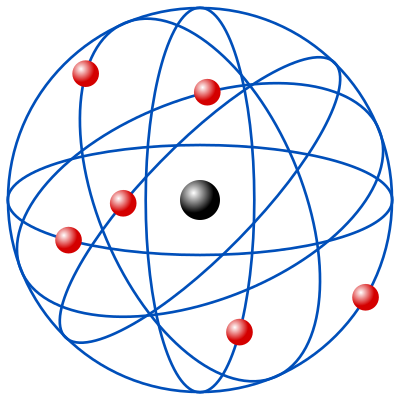
This LO covers the historical development of atomic theory, the structure of the atom, subatomic particles, isotopes, isobars & isotones, and radioactive radiation (alpha, beta, gamma). Understanding how scientists discovered what atoms look like – through experiments, failures, and brilliant insights – is one of the most exciting stories in all of science. Master this, and the periodic table, bonding, and nuclear chemistry will all make sense.
Essential Question: "How is an atom similar to and different from a solar system?"
The idea that matter is made of tiny, indivisible particles is thousands of years old. But it took over 2,400 years of debate, experimentation, and revolutionary thinking to get from ancient philosophy to the modern model of the atom.
Greek philosopher Democritus proposed that all matter is made of tiny, indivisible particles he called atomos (Greek: ἄτομος = "uncuttable"). He believed atoms were:
Democritus had no experimental evidence – this was pure philosophical reasoning. But his core idea – that matter is not continuous but made of discrete particles – turned out to be remarkably correct.
Greek philosopher Aristotle rejected the idea of atoms and the void entirely. He believed:
Because Aristotle was the most influential philosopher of the ancient world, his views dominated for nearly 2,000 years – pushing atomism into the shadows until the Scientific Revolution.
Exam point: Democritus' idea was a philosophical hypothesis, not a scientific theory – he had no experimental evidence. Aristotle rejected it and his influence delayed the development of atomic theory by ~2,000 years. Science requires evidence, not just reasoning.
English scientist John Dalton published the first scientific atomic theory, based on experimental evidence from studying chemical reactions and gas behaviour. His key postulates:
Dalton's model: The atom is a solid, indivisible sphere – like a billiard ball. No internal structure.
What he got right: Atoms exist, they combine in fixed ratios, and reactions rearrange atoms. What he got wrong: Atoms are NOT indivisible – they have internal structure. Not all atoms of the same element have exactly the same mass (isotopes).
British physicist Joseph John Thomson discovered the electron using a cathode ray tube experiment. He observed that:
Thomson calculated: C/kg
Thomson's model: The Plum Pudding Model (نموذج حلوى البرقوق)
The atom is a sphere of positive charge with negative electrons embedded throughout – like raisins (plums) scattered in a pudding. The positive and negative charges balance out, making the atom electrically neutral.
American physicist Robert Millikan measured the exact charge of an electron using his famous oil drop experiment:
Combined with Thomson's ratio, this allowed calculation of the mass of the electron:
New Zealand-born physicist Ernest Rutherford, along with his students Hans Geiger and Ernest Marsden, performed the gold foil experiment – one of the most important experiments in the history of science.
The experimental setup:
Procedure:
Expected results (based on Thomson's plum pudding model): If atoms are soft, uniform spheres of positive charge, all alpha particles should pass straight through with only slight deflections.
Actual results:
Rutherford famously said: "It was almost as incredible as if you fired a 15-inch shell at a piece of tissue paper and it came back and hit you."
Danish physicist Niels Bohr improved Rutherford's model by introducing the concept of quantised energy levels:
Key postulates:
British physicist James Chadwick discovered the neutron – an electrically neutral particle inside the nucleus.
The problem: Scientists knew the mass of the nucleus was roughly double what could be explained by protons alone. For example, helium has 2 protons (mass ≈ 2 amu) but a nuclear mass of ≈ 4 amu. Something else was in the nucleus.
The experiment: Chadwick bombarded beryllium with alpha particles. The beryllium emitted radiation that could knock protons out of paraffin wax. This radiation was electrically neutral (not deflected by electric or magnetic fields) but had significant mass. Chadwick identified these as neutrons.
Exam summary – Evolution of Atomic Models:
| Scientist | Year | Model | Key Discovery |
|---|---|---|---|
| Dalton | 1803 | Solid sphere | Atoms exist; combine in fixed ratios |
| Thomson | 1897 | Plum pudding | Discovered electron; atom has internal structure |
| Rutherford | 1911 | Nuclear model | Tiny dense positive nucleus; mostly empty space |
| Bohr | 1913 | Planetary model | Quantised energy levels; electron orbits |
| Chadwick | 1932 | (Refined nuclear) | Discovered neutron |
Now that we know the history, let's look at the modern understanding of atomic structure.
Every atom is made of three types of subatomic particles:
| Particle | Symbol | Charge | Relative Charge | Mass (kg) | Relative Mass (amu) | Location |
|---|---|---|---|---|---|---|
| Proton | C | +1 | ~1 | Nucleus | ||
| Neutron | 0 | 0 | ~1 | Nucleus | ||
| Electron | C | −1 |
The number of protons in the nucleus of an atom. The atomic number defines the element – change Z and you change the element. For a neutral atom, also equals the number of electrons.
The total number of protons and neutrons (nucleons) in the nucleus: , where is the number of neutrons.
An atom is represented as:
where is the element symbol, is the mass number (top), and is the atomic number (bottom).
Carbon-12:
Oxygen-16:
Protons = Atomic number (Z)
Look up the element on the periodic table. The atomic number IS the number of protons.
Neutrons = Mass number − Atomic number = A − Z
Subtract the atomic number from the mass number.
For a neutral atom: Electrons = Protons = Z
For an ion: Electrons = Protons − Charge
An atom or group of atoms that has gained or lost one or more electrons, giving it a net electrical charge.
An atom that has lost one or more electrons.
Result: More protons than electrons → positive charge
Example: – Sodium atom (11p, 11e) loses 1 electron → (11p, 10e)
Who forms cations? Mainly metals – they have few valence electrons and lose them easily.
An atom that has gained one or more electrons.
Result: More electrons than protons → negative charge
Example: – Chlorine atom (17p, 17e) gains 1 electron → (17p, 18e)
Who forms anions? Mainly non-metals – they need a few more electrons to fill their outer shell.
Calculate the subatomic particles for (Iron(III) ion):
The ion has lost 3 electrons, so it has 23 electrons instead of 26.
Calculate the subatomic particles for (Sulfide ion):
The ion has gained 2 electrons, so it has 18 electrons instead of 16.
Atoms of the same element that have the same number of protons (same Z) but a different number of neutrons (different A). Isotopes have identical chemical properties but different physical properties (mass, density, radioactivity).
Key rule: Same element → same protons → same electrons → same chemical behaviour. But different neutrons → different mass → different physical properties.
| Isotope | Symbol | Protons | Neutrons | Mass Number | Name |
|---|---|---|---|---|---|
| Hydrogen-1 | 1 | 0 | 1 | Protium (بروتيوم) | |
| Hydrogen-2 | 1 | 1 | 2 | Deuterium (ديوتيريوم) | |
| Hydrogen-3 | 1 | 2 | 3 | Tritium (تريتيوم) |
All three are hydrogen (1 proton each), but they differ in neutron count and mass.
| Isotope | Protons | Neutrons | Stable? | Use |
|---|---|---|---|---|
| 6 | 6 | Yes | Reference standard for atomic mass | |
| 6 | 7 | Yes | NMR spectroscopy | |
| 6 | 8 | No (radioactive) | Carbon dating (archaeology) |
| Isotope | Protons | Neutrons | Abundance |
|---|---|---|---|
| 8 | 8 | 99.76% | |
| 8 | 9 | 0.04% | |
| 8 | 10 | 0.20% |
Atoms of different elements that have the same mass number (same A) but a different atomic number (different Z). They are different elements with the same total number of nucleons.
and and
All three have mass number :
Same total nucleons (40), but different elements with completely different chemical properties.
Atoms of different elements that have the same number of neutrons but different atomic numbers and mass numbers.
and
Different elements, different mass numbers, but the same number of neutrons.
, , and
All have 16 neutrons → they are isotones.
Atoms or ions that have the same number of electrons. They have different numbers of protons but identical electron configurations.
, , , , all have 10 electrons:
| Species | Protons | Electrons |
|---|---|---|
| 8 | 10 | |
| 9 | 10 | |
| 10 | 10 | |
| Concept | Same | Different |
|---|---|---|
| Isotopes | Protons (Z) | Neutrons (N), Mass number (A) |
| Isobars | Mass number (A) | Protons (Z), Neutrons (N) |
| Isotones | Neutrons (N) | Protons (Z), Mass number (A) |
| Isoelectronic | Electrons | Protons (Z) |
Exam trap: Don't confuse these four terms! Remember:
The atomic mass listed on the periodic table is NOT the mass of any single atom – it's the weighted average of all naturally occurring isotopes, based on their relative abundance.
Chlorine has two naturally occurring isotopes:
This matches the value on the periodic table: 35.45 amu.
Boron has two naturally occurring isotopes:
The periodic table lists boron as 10.81 amu – a weighted average closer to because it's the more abundant isotope.
Some nuclei are unstable – they have too many or too few neutrons relative to protons, or they are simply too large. These unstable nuclei undergo radioactive decay, spontaneously emitting particles or energy to become more stable. The three main types of radiation are alpha (α), beta (β), and gamma (γ).
A particle consisting of 2 protons and 2 neutrons – identical to a helium-4 nucleus (). It has a charge of +2 and a mass of 4 amu.
Properties of alpha radiation:
Alpha decay equation – General form:
The parent atom loses 2 protons and 2 neutrons, so the atomic number drops by 2 (new element!) and the mass number drops by 4.
Uranium-238 alpha decay:
Uranium (Z=92) becomes thorium (Z=90). The atomic number decreased by 2, mass number by 4.
A high-speed electron emitted from the nucleus when a neutron converts into a proton. It has a charge of −1 and negligible mass.
Properties of beta radiation:
Key concept: The beta particle (electron) comes from inside the nucleus, NOT from the electron cloud. A neutron converts into a proton and an electron:
The is an antineutrino – a nearly massless, chargeless particle emitted alongside the electron.
Beta decay equation – General form:
The mass number stays the same (a neutron became a proton – total nucleons unchanged), but the atomic number increases by 1 (one more proton → new element).
Carbon-14 beta decay:
Carbon-14 (Z=6) becomes nitrogen-14 (Z=7). Mass number unchanged, atomic number up by 1.
A high-energy electromagnetic wave (photon) emitted from an excited nucleus. Gamma radiation has no charge and no mass – it is pure energy.
Properties of gamma radiation:
Gamma emission:
The asterisk (*) indicates an excited nuclear state. Gamma emission does NOT change the atomic number or mass number – it just releases excess energy. Gamma rays often accompany alpha or beta decay.
| Property | Alpha (α) | Beta (β) | Gamma (γ) |
|---|---|---|---|
| Identity | nucleus | (electron) | Electromagnetic wave |
| Charge | +2 | −1 | 0 |
| Mass | 4 amu | ~0 amu | 0 |
| Speed | 5–7% of | Up to 99% of | (speed of light) |
| Penetration | Low (paper stops it) | Medium (aluminium stops it) | High (lead/concrete needed) |
| Ionising power | Highest | Medium | Lowest |
| Deflection in fields | Yes (toward −) | Yes (toward +) | No |
| Effect on Z | Z − 2 | Z + 1 | No change |
| Effect on A | A − 4 | No change | No change |
Exam memory trick: Think of it as a trade-off:
Exam-critical: In ALL nuclear equations, both the mass numbers (top) and the atomic numbers (bottom) must balance on both sides. This is the law of conservation of mass and charge.
Check:
Questions sourced from past STEM exams, reference materials, and chemistry question banks. Use these to test your understanding of atomic structure, isotopes, and radioactive radiation.
Chemistry: A Molecular Approach (Tro):
Chemistry: The Central Science (Brown, LeMay, Bursten):
STEM Curriculum References:
Video Resources:
Related Learning Outcomes:
This confirmed electrons are incredibly light – about the mass of a hydrogen atom.
Rutherford's Nuclear Model:
Limitation: Rutherford's model couldn't explain why electrons don't spiral into the nucleus (a moving charged particle should radiate energy and collapse into the centre according to classical physics).
where is Planck's constant and is the frequency of the emitted/absorbed photon.
What Bohr explained: The hydrogen emission spectrum – the specific colours of light emitted by excited hydrogen atoms. His model correctly predicted the wavelengths of hydrogen's spectral lines.
Limitation: Bohr's model only works well for hydrogen (one electron). It fails for multi-electron atoms because it doesn't account for electron-electron repulsion.
Properties of the neutron:
The discovery of the neutron completed the picture of the three fundamental subatomic particles: proton, neutron, and electron.
| ~ ≈ 0 |
| Electron cloud |
| 11 |
| 10 |
| 12 | 10 |